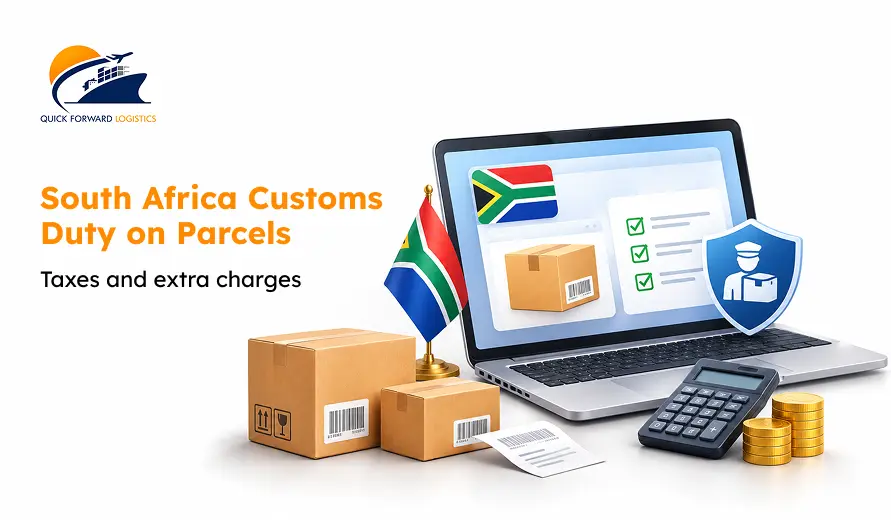
Sending a parcel from India to South Africa involves more than paying the international courier fee. The recipient may also need to pay import customs duty, Value Added Tax (VAT), and other charges before the shipment is released for delivery. The amount depends on the type of goods, their declared value, customs classification, country of origin, and applicable South African import rules.
Understanding South Africa customs duty on parcels before sending a shipment can help individuals and businesses prepare for the possible costs. Whether you are sending clothes, gifts, electronics, personal belongings, documents, or commercial products, the customs process may differ according to the contents and purpose of the shipment.
South Africa's customs authority, the South African Revenue Service (SARS), manages import duties and taxes. Courier companies and customs clearing agents may also charge service fees for processing shipments.
This guide explains how customs duty works in South Africa, which taxes may apply to international parcels, how customs values are assessed, what additional fees recipients may incur, and how to prepare a shipment from India to avoid avoidable complications.
How Does Customs Duty on Parcels Work in South Africa?
When an international parcel arrives in South Africa, it may be examined by customs officials before it is released to the recipient. Customs checks help authorities identify the goods, confirm their declared value, determine the applicable tariff classification, and assess whether import duties or taxes are due.
The customs process applies to parcels sent by individuals and businesses alike. A shipment does not automatically become exempt from customs charges simply because it is marked as a gift or sent to a family member.
For example, if someone sends a box of clothes from India to a relative in Johannesburg, customs may review the description, quantity, value, and country of origin of the clothing. The applicable charges depend on the tariff classification and the customs value accepted by SARS.
The main charges that may apply include:
- Customs duty: A tax based on the tariff classification and customs value of the imported goods.
- Value Added Tax (VAT): Import VAT may be payable on taxable imported goods.
- Excise duty: Certain products, including specific alcohol and tobacco products, may attract excise-related charges.
- Customs clearance fees: A courier company or clearing agent may charge for processing the shipment.
- Other applicable charges: Storage, inspection, handling, or regulatory fees may apply in certain circumstances.
These expenses make it important to understand Customs Charges in South Africa before sending an international parcel. Not every shipment incurs every charge. The final amount depends on the goods, their classification, customs value, applicable exemptions, and the clearance method.
What Taxes Apply to Parcels Entering South Africa?
International parcels entering South Africa may be subject to multiple taxes. Customs duty and VAT are separate charges, and both may apply to the same shipment.
1. South African Customs Duty
Customs duty is determined by the tariff classification of the imported goods. Different products can have different duty rates, even when their declared values are similar.
For example, clothing, footwear, electronics, household products, and machinery may fall under different tariff headings. The applicable rate depends on the product's proper classification and the relevant customs rules.
The duty rate may also depend on the country of origin and on whether a preferential trade arrangement applies. The country from which a parcel is dispatched is not always the same as the country where its contents were manufactured.
Before shipping goods, confirm the applicable tariff classification and duty rate with SARS or a qualified customs professional.
2. South Africa Import Tax on Parcels
South Africa applies a standard VAT rate of 15%. Import VAT may apply to goods brought into the country, subject to applicable VAT rules and exemptions.
Import VAT is generally calculated based on a customs value that includes the applicable customs duty and an additional uplift prescribed under South African VAT rules.
In simplified terms, the calculation may involve:
Import VAT = 15% × (Customs value + applicable uplift + customs duty)
The exact calculation depends on the import circumstances and applicable legislation. The customs value and duty should be determined before estimating the VAT amount.
For example, if a parcel contains taxable goods, SARS may calculate import VAT based on the accepted customs value, the prescribed uplift, and any applicable customs duty. This means the recipient should not assume that VAT will be calculated solely on the original purchase price.
3. Excise Duty on Certain Goods
Some products may attract excise duty or other product-specific charges when imported into South Africa.
These may include alcoholic beverages, tobacco products, and other goods subject to excise legislation. Additional restrictions, permits, or documentation may also apply.
Before sending such items, confirm whether the product is permitted and what taxes or approvals are required. Some products may be prohibited or subject to strict import controls.
How Is South Africa Customs Duty on Parcels Calculated?
The customs amount is not determined solely by parcel weight. Customs authorities generally consider the nature of the goods, their customs value, tariff classification, origin, and applicable import rules.
Understanding these factors can help senders prepare accurate shipment details.
1. Determine the Customs Value
The customs value is the starting point for calculating many import charges. It is generally based on the transaction value of the goods, subject to customs valuation rules and any required adjustments.
Depending on the shipment and the valuation method, relevant transportation and insurance costs may also be considered.
For example, suppose a sender in India ships a commercial product to a customer in Cape Town. The declared value should reflect the goods' actual value and be supported by the relevant invoice or other evidence.
For personal gifts or used belongings with no sale, the sender should provide a reasonable and accurate value. Declaring an item as having no value simply because it is a gift can prompt customs questions.
2. Identify the Correct Tariff Classification
Every imported product requires an appropriate tariff classification. This classification helps customs authorities identify the product and determine the applicable duty rate and import conditions.
For example:
- Clothing may fall under textile and apparel tariff headings.
- Mobile phones may fall under telecommunications equipment classifications.
- Shoes may be classified according to their material and construction.
- Kitchen equipment may have a different classification depending on its type and function.
A broad description, such as "household items" or "personal goods," may not provide sufficient information for customs assessment.
Use clear descriptions that identify the products, their materials, and their intended use.
3. Check the Country of Origin
The country of origin is the country where the goods were produced or manufactured under the relevant origin rules. It is not necessarily the country from which the parcel is sent.
For example, a product manufactured in China and shipped to South Africa from India does not automatically become an Indian-origin product.
Origin may affect the applicable duty rate when a trade agreement or preferential arrangement is available. Supporting origin documents may be required to claim a preference.
4. Apply the Applicable Duty and VAT
Once the customs value, tariff classification, and origin are determined, the applicable duty rate can be applied. Import VAT and any other applicable charges are then assessed under South African rules.
The following example is for explanatory purposes only and does not represent an actual South African customs assessment.
| Shipment detail | Example amount |
| Customs value used for illustration | R2,000 |
| Illustrative customs duty rate | 10% |
| Customs duty | R200 |
| Illustrative uplift for VAT calculation | 10% |
| VAT calculation base | R2,420 |
| Import VAT at 15% | R363 |
| Illustrative duty and VAT total | R563 |
The example assumes a 10% duty rate and a 10% uplift solely for illustrative purposes. Actual duty rates, valuation adjustments, and applicable charges must be verified against current SARS rules and the product's tariff classification.
Do Gifts and Personal Parcels Attract Customs Duty in South Africa?
Many people assume that gifts sent to family members are automatically exempt from customs duty. However, marking a parcel as a gift does not, by itself, remove customs obligations.
South African customs rules may offer limited relief for qualifying personal gifts under certain conditions. Eligibility may depend on the nature of the goods, their value, quantity, frequency, and the applicable customs provisions.
A gift sent from India to a family member in South Africa may still require:
- A clear description of every item.
- An accurate declared value.
- The sender's and recipient's contact details.
- Supporting invoices or other value information where available.
- Any additional documents requested by customs.
Personal belongings also require accurate descriptions. Used clothing, books, household goods, and other personal items should not be classified as commercial products or assigned an unrealistic value.
If you are sending a gift, ask the courier company whether any specific gift relief applies before booking. Do not assume that a gift declaration means the recipient will not pay taxes.
For this reason, check the applicable import duties on gifts to South Africa before dispatch, especially when sending valuable items or multiple products in one parcel.
Additional Charges When Sending Parcels to South Africa
In addition to customs duty and VAT, international parcels may incur other charges during transportation and clearance.
Not all of these fees are government taxes. Some are service charges collected by the courier company, customs broker, or another service provider.
| Additional charge | Why it may apply |
| Customs clearance fee | Processing the shipment through customs |
| Disbursement fee | A service fee when the courier advances duties or taxes on behalf of the recipient |
| Storage fee | The parcel remains at a facility beyond the permitted period |
| Inspection or handling fee | Additional handling during customs examination |
| Remote-area delivery fee | The destination falls outside the standard delivery area |
| Address correction fee | The recipient's address needs correction |
| Return shipment fee | The parcel cannot be delivered and must be returned |
| Special handling fee | The shipment requires approved additional handling |
The exact charges depend on the courier company's terms and the shipment's circumstances.
Before booking, ask whether the quotation includes customs clearance, duties, taxes, and delivery fees. Also confirm whether the recipient must pay any charges before the parcel is released.
How to Complete Parcel Customs Clearance in South Africa
Accurate documentation helps customs authorities identify the shipment and assess applicable charges. Missing or inconsistent paperwork may cause delays or prompt requests for additional information.
Parcel Customs Clearance in South Africa may require the following documents, depending on the goods and the type of shipment.
1. Commercial Invoice
A commercial invoice is typically required for goods sold or supplied to a buyer. It should identify the products, quantities, unit values, total value, currency, and relevant transaction details.
2. Customs Declaration
The customs declaration provides information about the parcel's contents, value, quantity, and purpose. The information should match the actual items inside the package.
3. Packing List
A packing list provides an item-wise record of the contents. It is particularly useful for shipments containing several different products.
4. Proof of Value
Customs authorities may request purchase invoices, payment records, receipts, or other supporting documents to verify the declared value.
5. Permits or Product Certificates
Certain products may require import permits, safety documents, health certificates, or other approvals. This can apply to regulated food products, medicines, cosmetics, agricultural goods, and specialised equipment.
The required documents depend on the type of shipment. Check the requirements before dispatch rather than waiting until the parcel reaches South Africa.
How to Avoid Unexpected Customs Charges on Parcels to South Africa
You cannot always avoid customs duty or import VAT when sending taxable goods. However, accurate shipment information and proper preparation can help prevent unnecessary fees and clearance problems.
1. Declare the Correct Value
Always provide the genuine value of the goods. Do not reduce the declared value to make the shipment appear cheaper.
An incorrect declaration can result in customs reassessment, additional documentation requests, penalties, or delays.
2. Use Clear Product Descriptions
Avoid vague descriptions such as "items", "gifts", or "samples" without further details.
Instead, identify the actual products. For example, write "two cotton shirts" rather than simply "clothes".
3. Check Import Restrictions
Some goods may be restricted, require permits, or be prohibited from entering South Africa. Check the applicable rules before packing medicines, food, plants, animal products, batteries, and other regulated items.
4. Keep Invoices and Supporting Documents Ready
Keep purchase invoices, receipts, product details, and other relevant records available. These documents can help support the declared value and product description if customs requests additional information.
5. Ask About All Possible Fees Before Booking
Request a detailed quotation from the courier company. Ask about transportation charges, clearance fees, disbursement charges, duties, VAT, and any destination-specific costs.
This gives the sender and recipient a clearer idea of the total amount that may be payable.
How Quick Forward Logistics Can Help with Parcels to South Africa
Sending an international parcel involves transportation, paperwork, customs declarations, and delivery coordination. Choosing a courier service that can explain the booking and documentation process can make preparation easier.
Quick Forward Logistics provides international courier services for individuals and businesses sending shipments from India to overseas destinations.
Whether you are sending personal belongings, gifts, documents, or commercial products to South Africa, prepare the following details before requesting a quotation:
- Parcel weight and outer dimensions.
- Complete description of the items.
- Declared value and currency.
- Sender's address and contact information.
- Recipient's complete South African address and phone number.
- Any available invoices or supporting documents.
The courier team can use these details to assess the shipment requirements, explain the available service options, and advise what information may be needed for dispatch.
For customs-related charges, ask which fees are included in the quotation and which amounts may be collected separately during import clearance. The final assessment of customs duty and taxes remains subject to South African customs rules and the authorities' decision.
Final Words
Understanding South Africa customs duty on parcels is important before sending gifts, personal belongings, or commercial goods from India. The final import cost may include customs duty, 15% VAT, and additional courier or clearance charges. The applicable amount depends on the goods, customs value, tariff classification, country of origin, and current import rules.
Before dispatch, provide accurate product descriptions, declare the correct value, prepare the required documents, and ask about possible destination charges. These steps can help reduce customs queries and prevent unexpected costs for the recipient.
Quick Forward Logistics can assist with international parcel booking from India to South Africa. Share your shipment details before booking to discuss available courier options, documentation requirements, and the charges that may apply during delivery.