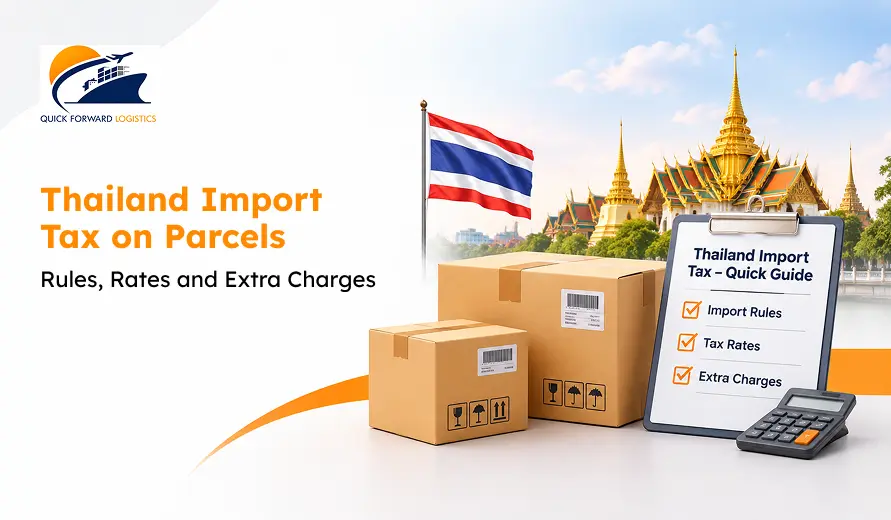
Sending a parcel to Thailand involves more than paying the international courier fee. Depending on the shipment's contents, declared value, product category, and customs classification, the recipient may also need to pay import duty, value-added tax (VAT), and other applicable charges. Understanding Thailand import tax on parcels before dispatch can help senders and recipients prepare for the total cost and avoid unexpected payment requests.
Whether you are sending clothes to Bangkok, gifts to a family member in Phuket, personal belongings to Chiang Mai, or commercial samples to a business in Thailand, customs rules apply to international shipments. Charges vary by parcel. Some goods may qualify for specific exemptions, while others may require additional documents or import permits.
This guide explains Thailand's parcel import rules, how customs duties and VAT are calculated, which extra charges may apply, and what senders in India should check before booking an international courier.
What Is Thailand Import Tax on Parcels?
Thailand import tax on parcels refers to government charges that may apply when goods enter Thailand from another country. These charges are separate from the transportation fee collected by an international courier company.
The main taxes and charges that may apply include:
- Import duty: A customs charge based on the product's classification, customs value, and applicable tariff rate.
- Value-added tax (VAT): A consumption tax applied to imported goods according to Thai tax rules.
- Excise tax: May apply to specific product categories, such as certain alcohol, tobacco, and other excise-controlled goods.
- Customs-related fees: Charges for clearance, handling, storage, or other services, depending on the shipment and service provider.
For example, if someone sends a parcel containing clothes from India to Bangkok, Thai customs may assess the shipment based on its declared value, product classification, and applicable import rules. The recipient may have to pay Thailand customs duty on parcels and VAT before the parcel is released for delivery.
A gift or personal parcel is not automatically exempt from customs charges. The actual treatment depends on the goods, their value, purpose, and the rules in force when the shipment arrives.
Thailand Import Duty and VAT Rates: What Should You Expect?
Thailand does not apply one fixed import duty rate to every parcel. Import duty rates depend on the product's Harmonized System (HS) code, which identifies the type of goods being imported.
Different products can have different tariff rates. Clothes, electronics, books, footwear, cosmetics, and household products may fall under separate classifications.
VAT is another important part of the calculation. Thailand's standard VAT rate is generally 7%, subject to the applicable legal rate and any extension or change in force at the time of import. Import VAT in Thailand is generally calculated using the customs value plus import duty and other applicable taxes or charges included in the tax base.
The following table provides a general overview:
| Tax or charge | How it applies |
| Import duty | Depends on the product's HS code and applicable tariff rate |
| Import VAT | Generally 7%, subject to the rate in force |
| Excise tax | Applies to certain product categories |
| Customs clearance fee | May be charged by the courier or customs broker |
| Storage or handling fee | May apply when additional processing or storage is required |
These are general explanations, not a confirmed tax calculation for a particular parcel. The exact amount depends on the shipment details and current Thai customs rules.
Does Thailand Charge Import Tax on Low-Value Parcels?
Low-value parcels should not automatically be treated as tax-free. Thailand's rules for low-value imports have changed, and the treatment of goods can depend on the date of import, declared value, product category, and applicable customs procedures.
For parcels arriving from overseas, senders and recipients should check the current Thai Customs Department requirements rather than relying on older information about a tax-free threshold.
A parcel with a low declared value may still require a customs declaration and may be subject to applicable import taxes. The recipient should also check whether the courier company collects taxes and clearance charges before delivery.
How Is Thailand Import Tax on Parcels Calculated?
Thai customs generally assesses imported goods using their customs value and product classification. The declared value alone may not always represent the final customs value used for tax calculation.
For many shipments, the customs value is based on the Cost, Insurance and Freight (CIF) value. This generally includes the value of the goods, insurance, and freight costs up to the relevant point of importation, subject to customs valuation rules.
Understanding Thailand parcel customs charges is important because the final amount can include more than the product's purchase price.
A simplified calculation can help explain the process.
Step 1: Determine the Customs Value
Suppose a parcel contains permitted personal items with these hypothetical values:
- Goods value: ₹5,000
- Freight cost: ₹1,000
- Insurance: ₹100
The simplified CIF value is ₹6,100.
For an actual shipment, customs will use the appropriate valuation method and currency conversion rate under Thai rules. The figures above are only an example.
Step 2: Identify the Import Duty Rate
The import duty rate depends on the product's HS code and the applicable tariff schedule.
For example, assume a hypothetical product attracts a 10% import duty rate.
Import duty = ₹6,100 × 10%
Import duty = ₹610.
This rate is used only to explain the calculation. It is not a confirmed tariff for clothes, gifts, electronics, or any other product.
Step 3: Calculate VAT
For a simplified example, assume the applicable VAT rate is 7%.
Import VAT is calculated on the customs value plus import duty and other applicable amounts included in the VAT base.
VAT = (₹6,100 + ₹610) × 7%
VAT = ₹469.70.
Step 4: Add Other Applicable Charges
The courier company may collect customs clearance fees, handling charges, storage fees, or other service charges where applicable.
Using the example above:
| Cost component | Example amount |
| Customs value | ₹6,100 |
| Import duty | ₹610 |
| Import VAT | ₹469.70 |
| Other courier or clearance fees | Depends on the service |
| Total tax before other fees | ₹1,079.70 |
This example shows why the final amount can be higher than the original product value. Actual assessments are made by Thai customs according to the applicable valuation, classification, and tax rules.
Which Parcels May Be Subject to Thailand Customs Duty?
Many types of goods can enter Thailand through international courier services, but their customs treatment varies.
Common parcel categories include:
1. Clothes and Footwear
Clothes, shoes, and fashion accessories may attract import duty and VAT depending on their classification and customs value. The recipient should provide accurate product descriptions and quantities.
2. Electronics and Accessories
Electronic products, chargers, computer accessories, and other devices may require specific HS classifications. Some products, particularly those involving wireless communication or radio equipment, may also be subject to regulatory requirements.
3. Gifts and Personal Belongings
Gifts sent to friends or family members may still be assessed for import taxes. Declaring an item as a gift does not automatically remove customs obligations.
Personal belongings may receive different treatment depending on the circumstances, applicable exemptions, and supporting documents.
4. Books and Printed Materials
Books and printed materials may have different tariff treatment from other goods. Their classification and any applicable exemptions should be checked before dispatch.
5. Food, Cosmetics, and Medicines
Food products, cosmetics, supplements, and medicines can involve additional import conditions. Some items may require permits, product registration, or approval from relevant Thai authorities.
The courier company should confirm whether the items can be accepted and whether any supporting documents are required.
Extra Charges When Sending Parcels to Thailand
Import duty and VAT are not the only expenses that may arise during international parcel delivery. Thailand parcel customs charges can also include additional fees from the courier company, customs broker, or other service providers.
| Extra charge | Why it may apply |
| Customs clearance fee | The courier or broker handles customs processing |
| Storage fee | The parcel remains in storage while awaiting documents or payment |
| Handling fee | Additional processing is required |
| Inspection-related costs | Additional services may be needed during customs examination |
| Remote-area delivery fee | The destination falls outside the standard delivery area |
| Address correction fee | Recipient information needs correction |
| Return shipment fee | The parcel cannot be delivered or is returned |
| Insurance charge | Optional shipment protection is selected |
Not every shipment will attract these charges. Ask the courier company which fees are included in the quotation and which may be collected separately.
It is also important to understand who pays the import charges. Depending on the shipping arrangement, the sender may pay certain costs in advance, or the recipient may need to settle the amount before delivery.
When comparing shipping charges to Thailand from India, check whether the quotation covers only transportation or also includes additional courier and clearance services.
What Happens If a Parcel Is Held by Thailand Customs?
A parcel may be held for customs review when officials need more information about its contents, value, classification, or import eligibility.
Common reasons include:
- Incomplete customs declarations.
- Incorrect or unclear product descriptions.
- Missing invoices or supporting documents.
- Questions about the declared value.
- Restricted or regulated products.
- Unpaid import duty or VAT.
- A requirement for an import permit or additional approval.
If a parcel is held, the recipient or courier company may receive a request for documents or payment. The sender should keep copies of the invoice, shipping details, product information, and proof of value.
Do not ignore customs notifications. Delays in providing documents or paying applicable charges may lead to storage fees, return arrangements, or other consequences under the relevant rules.
Documents Required for Sending a Parcel to Thailand from India
Correct paperwork helps customs officials identify the shipment and assess its contents. Following the Thailand customs clearance process starts with providing accurate shipment information and the required documents.
Commonly required documents include:
- Commercial invoice: Generally required for commercial shipments and should show the product description, quantity, value, and relevant transaction details.
- Customs declaration: Provides details about the parcel's contents and purpose.
- Packing list: May be requested for shipments containing several different products.
- Sender and recipient details: Full names, addresses, and contact numbers.
- Product permits or certificates: Required for certain regulated goods.
- Proof of value: An invoice, purchase receipt, or other supporting record may be requested.
For personal gifts, provide a clear description of each item and a reasonable declared value. Do not write only "gift" or "personal items" when a more specific description is available.
For commercial shipments, make sure the invoice and packing list match the actual contents. Differences between the paperwork and parcel can lead to customs questions.
How to Reduce Unexpected Import Charges in Thailand
You cannot always avoid import duty or VAT when sending a parcel to Thailand. However, careful preparation can help prevent avoidable costs and delays.
1. Declare the Correct Value
Provide the actual value of the goods and keep supporting records. Declaring an artificially low value can lead to customs reassessment, penalties, or delays.
2. Use Accurate Product Descriptions
Describe every item clearly. Include the product type, material, quantity, and other relevant details where needed.
3. Check the HS Code
Ask the courier company or customs specialist to help identify the appropriate HS code. The correct classification is important because the tariff rate depends on it.
4. Confirm Import Restrictions
Check whether the product needs a permit or is prohibited before sending it. This is particularly important for food, medicines, cosmetics, electronics, and regulated goods.
5. Ask for a Complete Courier Quotation
Compare the transportation fee, fuel surcharge, customs clearance fee, and other possible charges. A complete quotation gives you a clearer view of the expected shipping expense.
6. Keep the Recipient Informed
Tell the recipient that customs duty, VAT, or courier-related charges may be payable before delivery. This can prevent confusion when the parcel reaches Thailand.
Why Choose Quick Forward Logistics for Shipping to Thailand?
Sending a parcel internationally requires correct shipment details, suitable packaging, and the right courier service. A courier partner can help you understand the booking process and identify the information needed for customs documentation.
Quick Forward Logistics provides international courier services for individuals and businesses sending parcels from India to overseas destinations, including Thailand.
Whether you are sending documents, clothes, gifts, personal belongings, or commercial samples, share the shipment details before booking. This allows the team to assess the parcel and provide a quotation based on its weight, dimensions, contents, and destination.
If you are planning on sending parcels to Thailand from India, ask the courier team about:
- Available delivery services to Thailand.
- Chargeable weight and transportation rates.
- Estimated delivery period.
- Customs declaration requirements.
- Possible clearance and handling fees.
- Shipment tracking and delivery arrangements.
For a quotation, provide the packed weight, outer dimensions, item descriptions, declared value, and complete recipient address in Thailand.
Final Words
Understanding Thailand import tax on parcels before sending an international shipment can help you prepare for customs duty, VAT, and other possible charges. The final amount depends on the product category, HS code, customs value, and rules applicable when the parcel enters Thailand.
Before booking, check whether your items are permitted, provide accurate descriptions and declared values, prepare the required documents, and ask the courier company about possible clearance fees. The recipient should also know that import charges may be payable before delivery.
Whether you are sending a personal gift to Bangkok or commercial samples to a business in Thailand, Quick Forward Logistics can help you assess your shipping requirements and request a courier quotation from India.